Whitbread is the UK’s largest hospitality business, employing c.31,500 people and a long-time constituent of the FTSE100.
Premier Inn is the largest hotel brand in the UK and has a growing presence in Germany. Our proposition is synonymous with providing high-quality and great value hotel rooms for our guests, and food and beverage (F&B), especially a hot breakfast, is a key part of the guest experience at Premier Inn.
The following are key elements of our investment case:
1) Long-term growth opportunity in the UK
Whilst we are already the clear market leader, we have significant growth potential to reach up to 125,000 rooms across the UK and Ireland. With a material reduction in independent supply following the pandemic and a subdued pipeline of new build hotels, we do not expect UK supply to recover to 2019 levels until at least 2028. Our flexible approach to property ownership means we are well placed to take advantage of this significant market opportunity by adding rooms at attractive rates of return through both new sites and extensions, as demonstrated by our Accelerating Growth Plan (AGP).Whilst we are already the clear market leader, we have significant growth potential to reach up to 125,000 rooms across the UK and Ireland. With a material reduction in independent supply following the pandemic and a subdued pipeline of new build hotels, we do not expect UK supply to recover to 2019 levels until at least 2028. Our flexible approach to property ownership means we are well placed to take advantage of this significant market opportunity by adding rooms at attractive rates of return through both new sites and extensions, as demonstrated by our Accelerating Growth Plan (AGP).
86,000
Open rooms
96,000
Open rooms by 2030/31
125,000
Long-term potential rooms
2) Unlocking value in Germany
Germany is a large and exciting market with significant volumes of leisure and business travel. The independent sector is larger than in the UK and has also been in decline. However, there is no clear leader in the branded budget segment, creating opportunity for Premier Inn. Having grown rapidly through a combination of acquisitions, conversions and new builds, we have 75 open hotels and with our committed pipeline are set to become one of the largest operators in Germany with a clear focus on accelerating returns by 2030/31.
>13,000
Open rooms
18,000
Open rooms by 2030/31
No. 1
Long-term ambition
3) Differentiated model underpins a market-leading proposition
Our operating model is a key source of competitive advantage. Being in control of all aspects of our operations ensures the delivery of a consistent, high‑quality product, whilst our scale and financial discipline mean we can continue to offer great value for our guests and attractive returns for our shareholders. A centralised approach to revenue management allows us to maximise revenue whilst managing our cost of sales by integrating our digital marketing and customer relationship management activity into our trading strategy. Our food and beverage offer is a key part of our proposition, especially a hot breakfast, and helps us to drive incremental revenue per available room (RevPAR). Our Force for Good sustainability programme ensures we are contributing positively to the communities where we operate and helps mitigate potential climate-related risks.

| Label | X | Y |
|---|---|---|
| Premier Inn | 42.1 | 29.5 |
| Hilton | 1.8 | 33.7 |
| Marriott | 3 | 26.1 |
| ibis | 9.1 | 3 |
| Airbnb | 15.5 | 10.1 |
| Holiday Inn Express | 11.9 | 5.8 |
| Holiday Inn | 13.4 | 11 |
| Travelodge | 24.4 | -0.8 |
| Crowne Plaza | 2.1 | 14.4 |
| Best Western | 4.3 | 5.2 |
4) Asset-backed balance sheet provides stability and enables growth
Retaining a flexible approach to property ownership and a strong balance sheet have allowed us to keep financing costs low whilst also providing significant commercial benefits, in the form of a strong financial covenant and being able to maximise site returns through our value creation cycle. Whilst the Group will continue to benefit from owning a substantial amount of freehold real estate, we will reduce the proportion held from c.50% in 2025/26 to 30% – 40% over time. We will recycle £1.5bn of our freehold property via sale and leasebacks and other disposals, to fund future growth and increasingly look to grow on a leasehold basis over the life of our Five-Year Plan.
Group freehold : leasehold mix
Now
Over time
5) Five-Year Plan to maximise shareholder returns
In response to a series of unexpected fiscal and macroeconomic headwinds, we undertook a detailed business review and have announced a Five-Year Plan to 2030/31. This will extend our market-leading position in the UK, accelerate cash flow and returns in Germany and deliver long-term value creation for shareholders. With a reduced level of capital intensity, a reduction in the amount of freehold property held by the Group and the expected increase in profitability over the life of the plan, our Five-Year Plan is designed to maximise shareholder returns over the medium and long term.
Five-Year Plan
Our Five-Year Plan will transform Whitbread into a higher margin, higher returning, pure-play hotel business.
UK:
Network expansion
We still see significant potential to grow our market share in the UK.
However, reflecting recent changes to employment costs as well as business rates, we have reappraised all of our projects to ensure we are allocating and prioritising capital spend optimally in order to maximise returns.
Performance in 2025/26
- c.600 new rooms opened
- c.600 lower returning rooms closed
Five-Year Plan actions
- Reappraised all projects to ensure we are allocating capex optimally
- Reallocating capex to highest returning growth opportunities
- Pipeline of 8,000 higher returning rooms
- Exit approximately 1,500 lower returning rooms
2030/31 outcomes vs 2025/26
- Incremental adjusted PBT† contribution of £110m
- 96,000 open rooms in the UK and Ireland, including AGP
2030/31 outcomes
Highlighted where the selected tab contributes.
- Incremental contribution versus FY26, assuming UK like-for-like sales and cost efficiencies offset non-business rates inflation and finance costs over the life of the Five-Year Plan.
Key initiatives deliver incremental profits of £275m by FY31
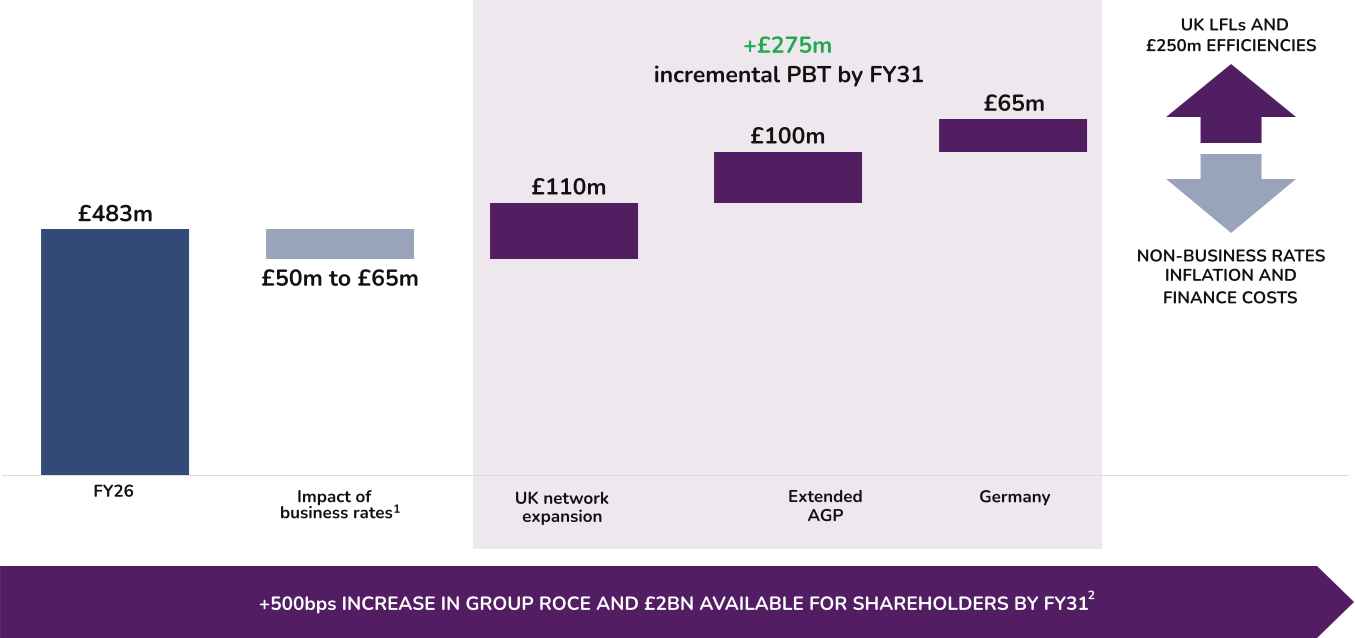
- Increase in business rates on UK LFL estate
- Incremental contribution versus FY26, assuming UK like-for-like sales and cost efficiencies offset non-business rates inflation and finance costs over the life of the Five-Year Plan
Capital Allocation: Unlocking £2bn available for shareholder returns by FY31
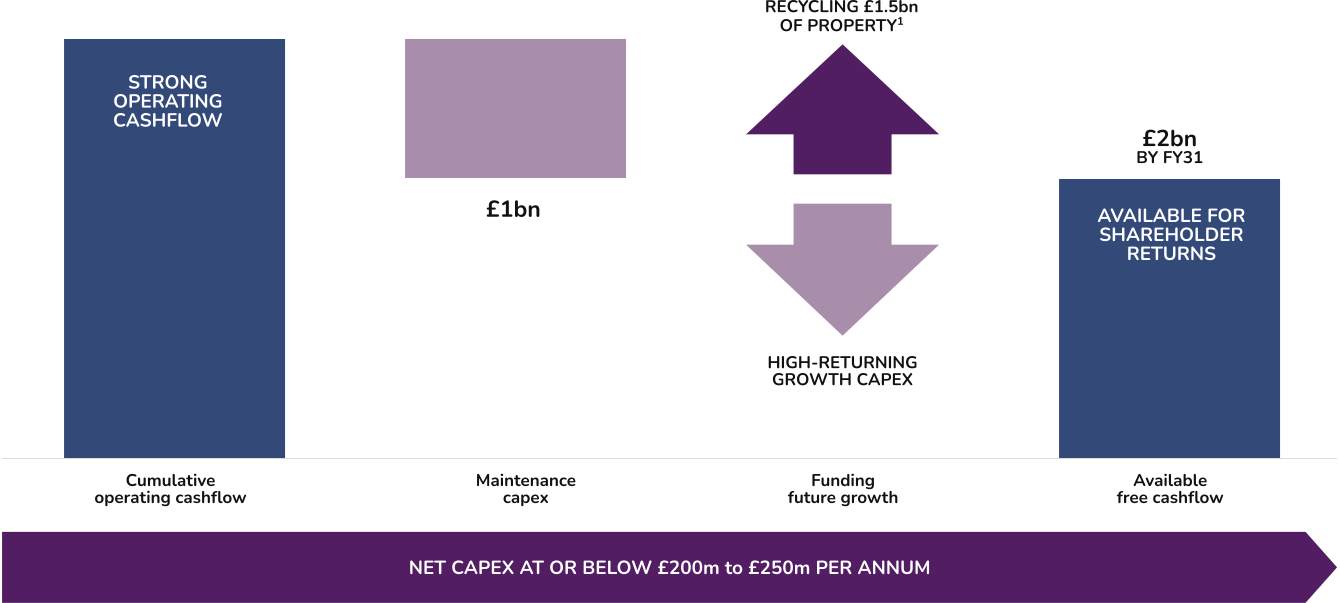
- Via sale and leasebacks and disposals